
Why can't we feel the Earth moving?
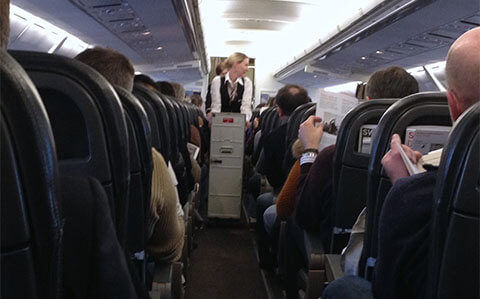
Short answer: Because we're moving at the same velocity as the Earth, in the same way that passengers inside an airplane don't feel movement because they're moving with the same velocity as the plane.
Long answer:
The Earth is rotating on its axis at about 1,675 km/h (1,040 mph)1, while orbiting the Sun at about 108,000 km/h (70,000 mph), while the entire Solar System orbits the centre of the galaxy at 720,000 km/h (450,000 mph). That's a lot of speed.
They key is that we don't feel velocity (speed in a given direction) as long as it's constant, or if the change is too subtle to notice.
More specifically, we don't feel speed or velocity at all. What we can feel is force on one part of our body that is different to the force on other parts. This means that we can feel acceleration such as when we're in a car that suddenly speeds up or slows down, or if it suddenly turns and changes velocity. As long as the car is travelling in a straight line at the same speed, the only movements we feel are the very small changes in velocity due to vibration. In a smooth plane ride this vibration is so small that you often can't feel it at all.
The Earth does not vibrate as it moves—it's a perfectly smooth motion. Therefore we don't feel it moving.
You might ask "Why doesn't the atmosphere create extreme winds if the Earth is moving so fast underneath it?". The answer is that the atmosphere is just like us—it's moving with the Earth. Of course there are local variations with pockets of air moving around and creating wind, just as there are air currents within an airplane. But the entire atmosphere is held on the Earth by gravity and moving at the same angular velocity.
See also:
Page information
Author: Dave Owen
Footnotes
1. At the equator—less nearer the poles.