
Perspective in the Flat Earth Theory
The concept of perspective comes up a lot in the flat Earth debate. It is used to explain many things, the most common example being the way the Sun and Moon rise and set. The globe Earth model says the Sun sets below the horizon because the Earth is rotating; the flat Earth model says that the Sun is always above ground and only appears to set due to perspective.
Before we look at the details, here are the basic rules of perspective that everyone agrees upon:
- Perspective is how three-dimensional scenes are represented on a two-dimension surface and seen by the human eye.
- Closer objects appear larger than more distant objects.
- Parallel lines appear to converge into the distance.
Sunsets
The time-lapse photo below shows the Sun setting. The flat Earth model states that this is an illusion; the second photo aims to show how this illusion is caused by perspective in the same way that streetlights appear to get closer to the horizon as they get farther away.
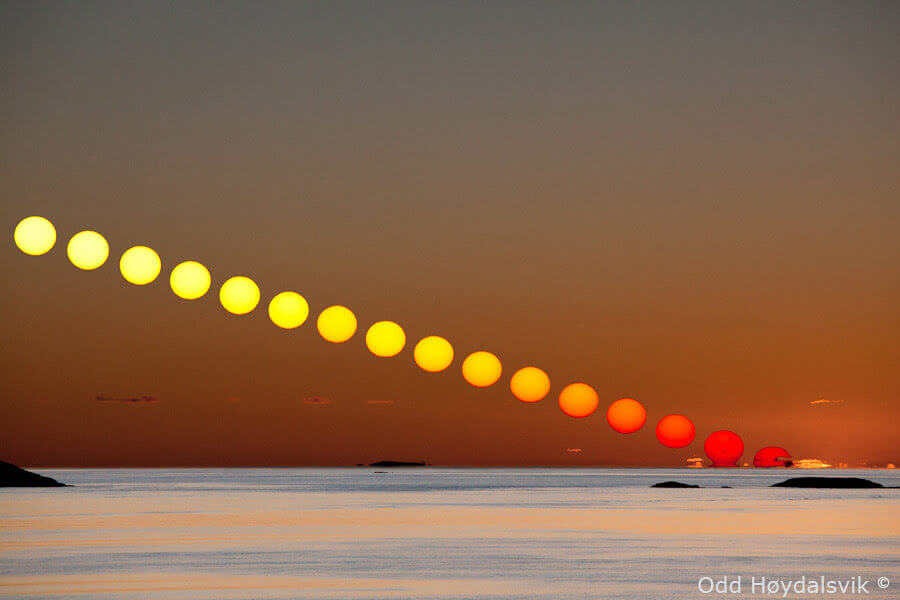
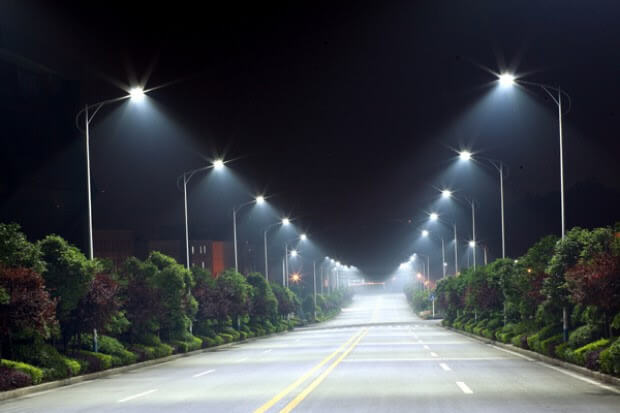
There is a problem with the perspective explanation. The streetlights get smaller as they get farther away, in accordance with how perspective works. However the Sun does not get smaller—it stays practically the same size wherever it is in the sky. Any tiny changes in size due to refraction or Earth's rotation are too small to see. If the sunset was caused by perspective the Sun would gradually appear smaller until it became too small to see at or near the horizon. Instead you can see that its size remains constant until it moves below the horizon bottom first.
This is the same for the Moon, and even easier to see with the naked eye.
There are two common counter arguments from flat-earthers:
(1) Some claim that the Sun does get smaller as it gets near the horizon. This is just silly—anyone can measure its size. It can be tricky with the Sun if you don't have a solar filter or solar telescope, but anyone can easily measure the size of the Moon. Try it yourself by holding your arm out and comparing the Moon to your little fingernail. On any given night the Moon stays effectively the same size as it moves across the sky.
(2) Another claim is that there is an atmospheric effect that makes the Sun and Moon look bigger as they get farther away, resulting in them appearing to be the same size. This is referred to by flat-earthers as atmospheric lensing. Apart from the fact that there is no supporting evidence for such an effect, the idea is obviously wrong because nothing else looks the same size as it gets farther away. Watch a plane or hot air balloon fly into the distance—it gets smaller. In addition, the whole point of the flat-earth argument is that the sunset is due to perspective. If the Sun doesn't appear to get smaller, there is no perspective effect and no explanation for the sunset.
The biggest clincher in this argument is that you can literally see the Sun and Moon rising and setting. You can easily watch the Moon move below the horizon, or rise from below it. Try it with binoculars or a telescope to see it even more clearly.
Constellations
The perspective argument is also used by flat-earthers to explain why different constellations are seen in different parts of the world. In the flat Earth model, as you move away from a constellation it gets smaller until it vanishes into the distance, while new constellations become visible in the direction you're moving towards.
This is easily disproved by simply measuring the size of any constellation. For example, the famous three stars of Orion's Belt have an angular diameter of 4.5 degrees. This is absolutely consistent. No matter where you see this group of stars from, it is always the exact same size.
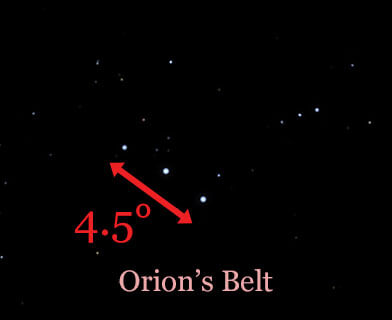
When a constellation sets, it moves below the horizon one star at a time, from the bottom of the constellation first. This doesn't fit the perspective explanation at all.
>> Back to the Flat Earth FAQ
Page information
Author: Dave Owen.